Tuesday, 6 November 2018

Welsh Highland Superpower 2018


We were up in Wales in mid-September... the plan had been so I (Ben) could do a miniatures shoot, but after some unplanned medical shenaniganary, I didn't get the model finished in time.  But as a consolation prize, the Welsh Highland Railway were having their 21st Anniversary Gala, "Superpower", so we thought we'd pay a visit.  The last time we went to one it was before The Childs moved in with us, and the weather was a bit grim, so we were interested to see what it was going to be like this year, especially as the forecast was for nice weather conditions.


All the fun and games were going on around Dinas Station; we got there nice and early, paid our entry  fee, and The Childs descended on the ride-on miniature railways, looked at the impressive model railways (Bron Hebog, a 009-scale recreation of the Welsh Highland around Beddgelert, was particularly excellent, massive and eye-catching), and they mugged us for sausage baps which were admittedly very tasty.

Outside, a regular service was running, particularly compared to the normal 2-a-day-each-way tourist train service that we see most of the time we're up there.  "Taliesin" of the Ffestiniog Railway is seen arriving above with a Waunfawr-Caernarfron shuttle (the Ffestiniog being physically connected to the WHR, so a big feature of the gala was the amount of their locomotives running special trains on Welsh Highland metals).


The main attraction, visiting engine-wise, was this impressive machine.  A new-build replica of the Lynton and Barnstaple Railway loco "Lyn" (originally built by Baldwin in the US), making a visit away from Devon.  It would appear that about three-quarters of all the narrow-gauge railway enthusiasts in the UK had turned up to get pictures of the loco too...


In an attempt to avoid just standing with the masses at the end of the platform, all getting identical shots, I went for the patented 'this is probably why I have a chest-muscle-condition problem' super low angle shot.  I wasn't too fond of this shot, except that I like the dramatic, coat-flapping stride of the chap on the right. 


Ducking out under the bridge to get a Ffestiniog Double-Fairlie,  "Merddin Emrys", leaving.  A surprising few photographers seemed willing to walk the 20-yards or so under the bridge to take pics away from the station, which given a tarmacked footpath parallels the line with a nice wire fence to poke lenses through, seemed a bit odd.  Nice not to have company for once though.


Hunslet "Lilla" was doing short rides with the Ffestiniog 4-wheel carriages up and down the yard, rides which were free once we'd paid entry to the site; the team manning the train were very friendly, to the point where The Childs insisted on multiple rides, which frankly neither Amy or myself minded.


Away from Dinas the weather was a bit manky (technical term that) which slightly naffed the attempt to photograph the Fairlie out in the countryside further along the line but to be honest we'd had such a good time at Dinas it didn't really matter.


Chronologically out of sequence, but my favourite shot of the day, "Merddin Emrys" and "Lyn" side-by-side at Dinas, and yes, ultra-low-angle too.

Friday, 19 October 2018

Intercity 2018... from the lineside


With the stop-motion film having fallen by the wayside, the second string to this particular project became the lineside pics.  I liked the idea of these being a series of shots taken at night whilst waiting for a train in some cold, desolate city station.  Very reminiscent of late-night cheap travel to and from University, waiting in the freezing cold at Carlisle, or changing trains at Stafford with expresses whizzing through.


I quite liked how this one came out, the high contrast with the lights of the Lima diesel shunter in the foreground.


Two attempts at having an express train rushing through the station.


...and one with a train racing towards the camera (though I prefer the header image at the top of this post).


Another shot, this time taken as if from aboard the train.


Then a couple from a high point of view, as if from a bridge high up over the entrance to the station, with the girder bridge sides in the foreground too for effect.


The concept having worked with the City Station pics, I decided to do the same sorts of shots with the other set-ups too.


Another shot as if from aboard the train, for the diesel loco depot setup.  I quite like this as it actually shows the depot, which wouldn't have been visible in the normal shots, but would have been in the planned stop-motion film.


The oil terminal set, with the lower-level partially visible for much the same reason.


The girder bridge set, with the tin-foil water more clearly visible, but unfortunately also the bodged nature of the bridge and the chocks holding up the ex-bookframe used for the trackbed.


The final shot of the whole project; a panning shot as if tracking the train over the bridge, from a street running parallel to the river.

Overall, a bit of a mixed bag of a project; the whole 'stop motion film' concept just didn't work for a variety of technical reasons... perhaps if I had access to a studio (rather than a cellar) I could have made a better go of it, likewise with different kit.  But then again, the point of doing this shoot was an attempt to try the idea before buying anything else.

On a more positive note, I feel that the stills shoot went well and allowed me to achieve the sorts of shots I wanted to all along; re-doing the sorts of pics I tried with the practise shoots.

Wednesday, 17 October 2018

Intercity 2018... Along the Line


After shooting the pics of the station, I rebuilt the set to portray various other scenes, for the purpose of both getting a variety of still photographs, and a number of different scenes for the stop-motion film.  The plan for the film was actually drawn out with a plan for a journey through an imaginary landscape, with scenes inspired by real locations, and this was an opportunity to test out how that might work out in practise.


Two scenes from the earlier test shoot I wanted to re-work, a cutting through a vaguely suburban area...


...and a goods yard.


Setting it up; the effect of the railway being in the cutting was achieved by using the tall sides of a dismantled bookcase balanced on blocks along either side of the scene.


The containers were ex-Britannia Model Village, the cranes are (I think) Playmobil, I got them broken for a few quid from a charity shop.  The streetlights are reading lights from Poundland.


The two industrial diesel shunters, the one on the right is the Lima 4-wheeled shunter bought to propel the camera dolly, the one on the left is a cut-down Triang Big-Big shunter bought way back as a parts donor for the Jabberwock build.


Trying out the trick with the tunnel (card folded, wedged between yet more bits of bookshelf).


Another one to redo, the line running under girder bridges in a cutting.


I went for something a bit different this time around, adding a diesel locomotive depot and a junction line.  The bridges are the same though, Tomy Thomas the Tank Engine sides. 


One slight issue with running along the curves was this ghosting effect.


Yet another pic I wanted to retry, the idea of the railway running along a raised embankment or viaduct between tower blocks and skyscrapers, not unlike the stretch of railway through central Manchester.


Again, almost all of the plastic crates, and the railway running along a raised bed made from the sides of the bookshelf.  Those curved bridge sides are ancient, they were made somewhat laboriously from card for the Model Village shoot all the way back in 2006.


For the impression of cars on the road below, I used two strings of Christmas tree lights.


This is one where the original shoot had it slightly better, it needed the fake viaduct sides, but a trial using them meant you couldn't see down into the supposed road below.


Another pic; the oil terminal (loosely inspired by Rowley Regis station when I was a child catching trains in the West Midlands).


This time I used the crates to try and make something a bit more industrial on the left, with some old metal table legs for chimneys.  The tracks on the lower-left are Tomy Thomas base plates from the city station (which also donated the arched roof bits for the City Station pic), and once again the oil tanks on the right are old soup containers.


Less successful than even the test pics, as regards the stills shoot, but the details on the lower-left, and the oil tanks, showed up better in the long exposure video.


Final one I wanted to re-do, travelling along the girder bridge.  This one never went right in the test shoots, as the camera was playing up and the lights I was using as headlamps to illuminate the tracks had also packed in.


The set was the previous one, re-dressed, with the girder bridge sides added along the edges of the bookshelf.  The crates were used to make something that looked a bit like a factory, and whilst I was happy with the chimneys I struggled with how to do the smoke, until I improvised with bubblewrap underlit.  The river surface was tinfoil, a trick I picked up from an old visual effects book.


Again, the streetlights for the road running along the river bank were the Poundland reading lights.


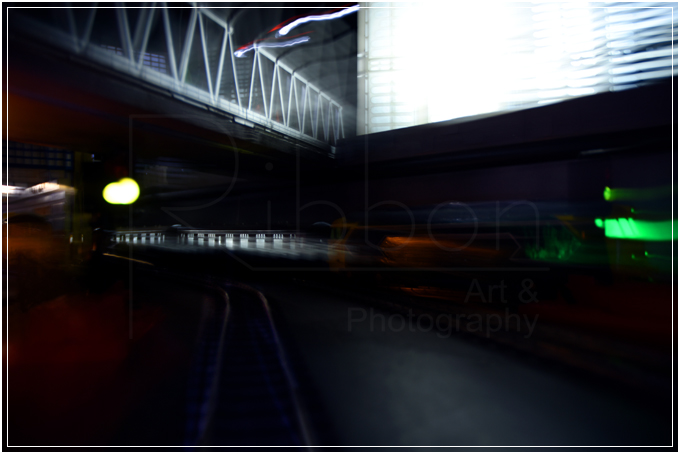
These shots are from the stop-motion film attempts.


I was much happier with the girder bridge effects this time, even if the resulting pics were accidentally a little too monochrome, a byproduct of the choice of lights and crates.


But most shoots are beset with problems, and this is as good a place as any to discuss how things went wrong.  The plan had been to shoot a series of long exposures which could be animated to show the journey along the railway as blurs, creating a very abstract short film... but then I had a lot of trouble with it.  Having to fire the shutter by remote was problematic, as it would randomly cut out and miss an odd shot here and there, meaning I had to reset the scene.  The first power controller running the motorised chassis failed on the second set-up and had to be replaced the next day, the camera was difficult to retrieve when it reached the end of the line (which had to be heavily padded to stop the camera smacking into the wall or tumbling onto the floor), and even with the new camera dolly the whole ensemble would still would occasionally overbalance and topple over, which was tricky to rescue as well from the middle of the set.

Possibly if I worked in a bigger scale where the camera would be more stable then it would have been less of an issue, but then trying to build the set to the bigger scale like gauge 1 (let alone the cost of buying trains) would have been prohibitive.  What finally naffed the idea was when the motorised Atlas chassis burned out from the weight of the camera, and with no time or budget to buy a replacement, or even make sure the new one would match the speed of the dead original, I just dropped the idea of doing the stop-motion film which I'd frankly been struggling with...  So more emphasis was placed on the lineside shots (of which more in the next, final, post on this project).